Getting a US visa should be the easy part of attending the World Cup. For thousands of fans, it has become the hardest.
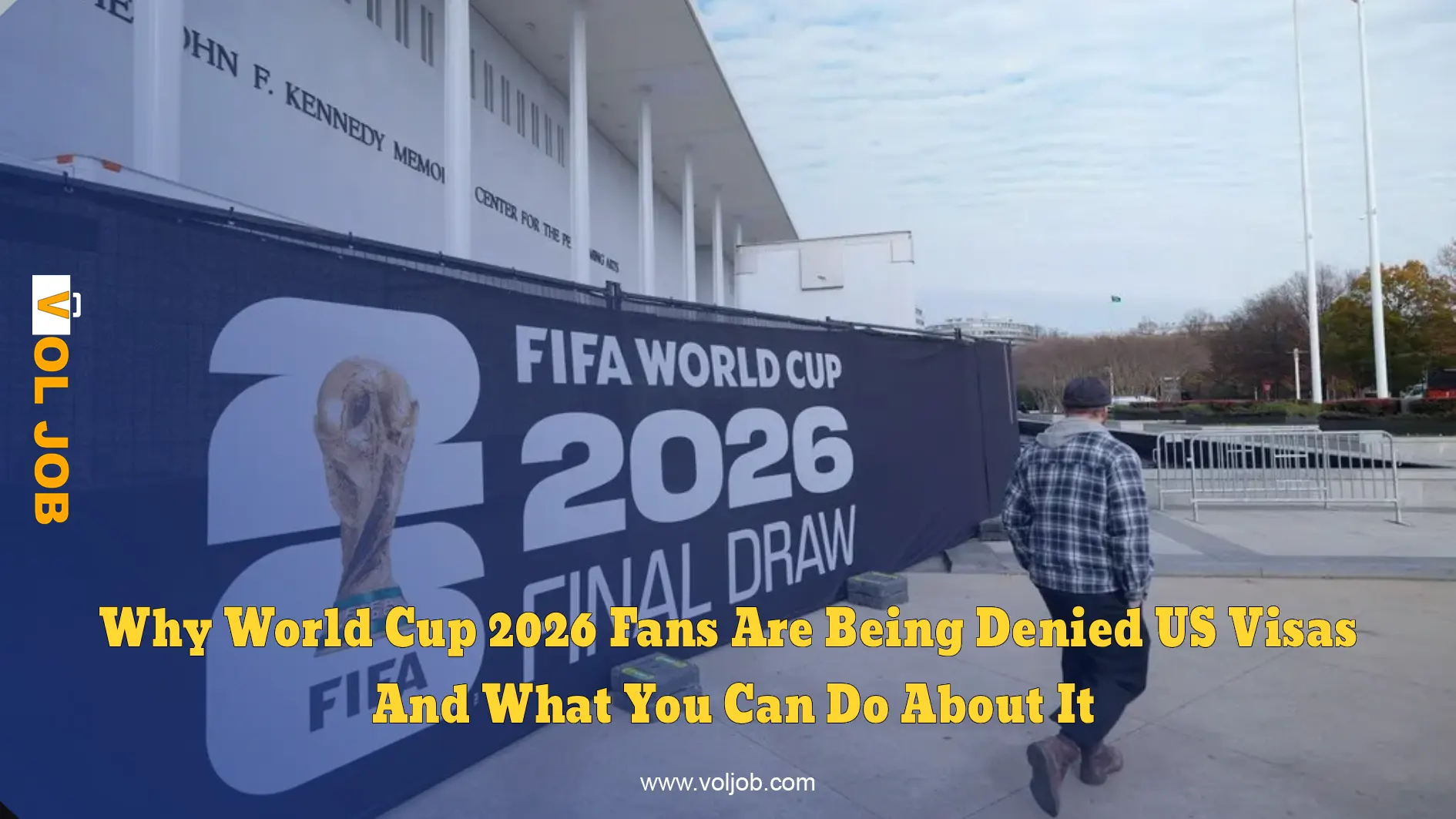
Reports from May and June 2026 confirm that dozens of supporters — many holding valid match tickets and hotel bookings — have been turned away by US consulates with little to no explanation. The most documented case involves a Moroccan supporters’ association, where 40 out of 42 applicants were denied visas despite having stable jobs, family ties, and full tournament bookings.
“No clear reasons were given for the visa refusals,” said the head of the Sports Association of Moroccan National Team Fans. “We just want to support our national team.”
Their story is not unique. From West Africa to South America and the Middle East, fans are losing thousands of dollars in non-refundable tickets and accommodation — and missing their national teams on the world stage.
This guide explains exactly why this is happening, which nationalities are most affected, and what steps you can take to improve your chances. For a broader overview of work and travel opportunities abroad, visit Voljob.com.
Common Legal Reasons for US Visa Denial
Most tourist visas to the United States fall under the B-1/B-2 category. According to the US State Department’s official visa guidelines, consular officers have broad discretionary authority, and rejections are rarely explained in detail. The most common legal grounds include:
Section 214(b) — Failure to Prove Non-Immigrant Intent
This is the most common reason for visa denial, and it is hitting World Cup fans particularly hard.
Under Section 214(b) of the US Immigration and Nationality Act, every applicant is presumed to be an intending immigrant unless they can prove otherwise. To overcome this presumption, you must demonstrate strong ties to your home country — a stable job, property ownership, a spouse or children, financial obligations — that make it clear you will return after the tournament.
For fans from lower-income countries or those without formal employment contracts, clearing this bar is extremely difficult, even with a match ticket in hand. Learn more about legal international travel and job opportunities that can help strengthen your visa profile.
Section 221(g) — Incomplete Application
A 221(g) refusal is technically a suspension, not a permanent denial. It means the consular officer needs additional documents or administrative processing before making a final decision. While it can be resolved, it risks causing fans to miss their matches due to processing delays.
Section 212(a)(6)(C) — Misrepresentation or Fraud
Providing false information — even an omission, such as failing to disclose a previously refused visa or a relative living in the US — can result in a permanent bar on future applications. Always be fully transparent in your application.
Section 212(a)(4) — Public Charge
If a consular officer believes you lack sufficient funds to support yourself during your stay and may rely on US government assistance, your application can be denied. This is especially relevant for fans from countries with lower average incomes.
Travel Bans: Which Countries Are Fully Blocked?
Beyond standard visa hurdles, the Trump administration has implemented sweeping presidential proclamations that restrict or suspend entry for nationals of dozens of countries. The American Immigration Council has documented the full impact of these measures on World Cup fans.
- Presidential Proclamation 10843 (signed June 4, 2025): Suspended all visa categories for nationals of 19 countries, primarily from the Middle East and Africa.
- Presidential Proclamation 10998 (effective January 1, 2026): Expanded the list to 39 countries total, adding 20 more nations.
Of the 48 teams competing in the 2026 World Cup, four have fans that are effectively banned from attending US-hosted matches:
| Country | Restriction Level |
|---|---|
| Iran | Full entry suspension |
| Haiti | Full entry suspension |
| Ivory Coast | Partial restrictions |
| Senegal | Partial restrictions |
Important note: Players, coaches, and accredited team staff from all banned countries are exempt from these proclamations under a specific World Cup carve-out. Their fans, however, are not.
Fans from banned countries who do not hold dual citizenship or a previously issued valid US visa cannot attend any of the 78 matches hosted in the United States.
Visa Bonds: The $15,000 Barrier
In addition to travel bans, the US State Department launched a Visa Bond Pilot Program in late 2025, requiring nationals of approximately 50 countries to deposit a financial bond — ranging from $5,000 to $15,000 — before obtaining a temporary US visa. Full details are available on the US State Department website.
The bond is refundable upon departure, but for fans from countries with average annual incomes below $5,000, it represents an insurmountable financial barrier.
Five World Cup-qualified nations were included in the bond program:
- Algeria
- Cape Verde
- Ivory Coast
- Senegal
- Tunisia
The Partial Good News
On May 13, 2026, the State Department announced a waiver of the visa bond requirement for fans from these five countries — but only under strict conditions:
- You must have purchased an official FIFA match ticket.
- You must have registered in the FIFA PASS Expedited Visa System before the April 15, 2026 deadline. More information is available on the official FIFA World Cup 2026 page.
If you missed that deadline, the bond requirement still applies.
Enhanced Security Screening
Certain nationalities face an additional layer of scrutiny beyond standard processing, including:
- Social media vetting: US authorities may request access to your social media account handles as part of security screening. Any content deemed suspicious can result in denial.
- Extended processing times: US consulates in Africa, the Middle East, and parts of Asia report processing times of 6 to 8 weeks during peak World Cup demand — even with a FIFA PASS appointment. Some slots are fully booked months in advance.
- Administrative processing: Some applications are placed into open-ended administrative review with no guaranteed timeline, effectively making attendance impossible even if the application is ultimately approved.
Countries reported to face heightened scrutiny include Morocco, Egypt, Jordan, and Uzbekistan, among others.
Tips to Strengthen Your Visa Application
If you are from a country that requires a B-1/B-2 visa, here is how to give yourself the best possible chance. For additional guidance on international travel documentation, explore the resources available at Voljob.com.
1. Apply as early as possible.
Consular capacity is severely strained ahead of the tournament. Apply months in advance, not weeks.
2. Document your ties to your home country.
Submit official proof of property ownership, an employment contract or payslips, family registration documents, and any financial obligations that require your return.
3. Show clear financial means.
Provide bank statements covering at least the past 3 to 6 months, demonstrating sufficient funds for travel, accommodation, and daily expenses in the United States.
4. Be completely transparent.
Disclose any prior visa refusals, any relatives living in the US, and any previous travel to the United States. Omissions — even unintentional ones — can result in permanent bars under Section 212(a)(6)(C).
5. Register for FIFA PASS.
Even if the April 15 bond-waiver deadline has passed, the FIFA PASS system can still help prioritize your consular appointment scheduling.
6. Never assume a ticket guarantees a visa.
Holding a FIFA match ticket does not obligate a consular officer to issue a visa. The two processes are completely separate.
Sources: US State Department, American Immigration Council, NPR, The Guardian, Hespress English, Wego Travel Blog — June 2026.
Frequently Asked Questions
Can fans from Iran or Haiti attend World Cup matches in Canada or Mexico instead?
Yes. The US travel ban applies only to US-hosted matches. The tournament also has matches in Canada and Mexico, which operate under their own separate immigration rules.
Is the visa bond refundable if my visa is denied?
Yes. Bonds are refundable if the visa is denied or if the traveler departs the US before their visa expires.
Does the FIFA PASS guarantee a visa appointment or approval?
Neither. FIFA PASS expedites the scheduling of consular interviews — it does not override visa assessment criteria or guarantee approval.
What should I do if my visa was denied under Section 214(b)?
You may reapply, but you should address the specific weakness in your application — typically by providing stronger documentation of your ties to your home country. Reapplying with the same application is unlikely to produce a different result.