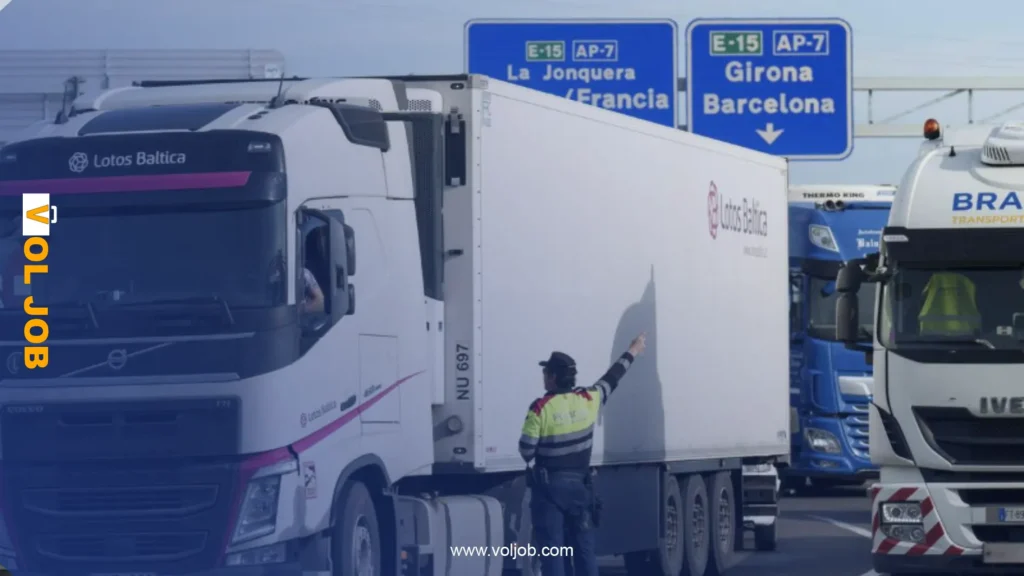
In a strategic move to address the growing crisis in the road transport sector, the Spanish government has launched a comprehensive reform of the professional driving license training system, aiming to fill the critical shortage of qualified drivers that has been weighing heavily on this vital industry.
A Structural Crisis Demanding Urgent Solutions
Spain is currently facing a shortage of more than 20,000 professional drivers, while the deficit across the European Union as a whole exceeds 400,000 drivers. This has pushed Madrid to seek quick and effective solutions to cover the growing shortfall in specialized labor, particularly given the high demand from transport and logistics markets.
Reforming the Training System: Digitalization Without Compromising Quality
The Spanish Council of Ministers approved key amendments to Royal Decree 284/2021, which governs the Certificate of Professional Competence (CAP). The core of these amendments revolves around expanding the use of remote learning for theoretical lessons, with the goal of reducing costs and time for trainees, while ensuring compliance with European directives regulating the sector.
Under these amendments, training centers are now authorized to deliver up to 66% of theoretical lessons remotely in a live interactive format, equivalent to:
- 166 hours within the standard training track (280 hours)
- 92 hours within the intensive training track (140 hours)
In all cases, interaction between instructors and trainees must take place in real time, without relying on pre-recorded sessions.
It is worth noting that this digital shift does not affect the core aspects of training. Practical driving instruction and final examinations remain in-person and mandatory, as they are fundamental pillars of professional driver qualification.
The new regulatory framework also allows for fully remote learning in exceptional circumstances such as natural disasters, health crises, and severe weather conditions, with these hours counted toward the in-person training quota, except for practical sessions.
On the administrative side, training centers are now permitted to replace biometric attendance systems with digital tools, handwritten signatures, or approved electronic records, in line with recommendations from the Data Protection Authority.
Opening Doors to Moroccan Professional Drivers
In a related development, Spain is moving toward easing the equivalence process for professional driving licenses issued in Morocco, as an additional measure to bridge the workforce gap. Under current arrangements, holders of Moroccan professional licenses are no longer required to pass a theoretical exam for equivalence purposes, while obtaining the Certificate of Professional Competence and passing the practical test remain non-negotiable requirements.
These facilitations open promising opportunities for Moroccan professional drivers to enter the Spanish labor market, particularly in the freight and passenger transport sectors, both of which are experiencing a significant shortage of qualified personnel.
Betting on Modernization While Upholding Standards
Madrid is counting on these reforms to make professional driving a more attractive and appealing career, by modernizing the training system and embracing digitalization as a means of removing barriers for those wishing to enter the sector, while maintaining the highest standards of quality and road safety that are non-negotiable in the road transport industry.
Read Also: Spain Eases Requirements for Recognizing Moroccan Driving Licenses: Everything You Need to Know