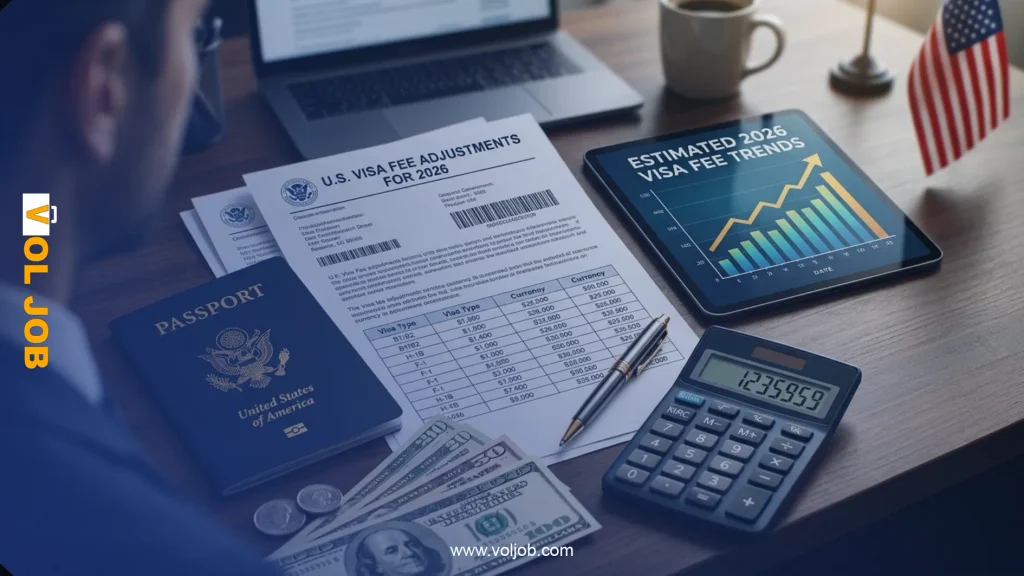
U.S. visa fees vary depending on the visa category and purpose of travel. In addition to the application processing fee, some applicants may need to pay other charges, such as a visa issuance fee or fees specific to certain visa categories. This guide summarizes the fees listed by the U.S. Department of State and explains the difference between temporary nonimmigrant visas, immigrant visas, and special consular services.
Please note: All amounts below are in U.S. dollars. Visa application processing fees are generally non-refundable. Fees and payment procedures may change or vary by country and embassy. Check the U.S. Department of State’s fee page and the instructions provided by the embassy before applying.
U.S. Nonimmigrant Visa Fees
Nonimmigrant visas are for temporary travel to the United States, such as tourism, study, or temporary work. The application processing fee depends on the visa category.
| Visa category | Examples | Application processing fee |
|---|---|---|
| Non-petition-based visas, except E | Business, tourism, or medical visits (B); transit (C-1); crewmembers (D); academic study (F); media (I); exchange visitors (J); vocational study (M); and other categories | $185 |
| Petition-based visas | Temporary workers or trainees (H), intracompany transferees (L), people with extraordinary ability (O), athletes and entertainers (P), cultural exchange visitors (Q), and religious workers (R) | $205 |
| E visa category | Treaty traders and investors, and certain Australian professionals | $315 |
| K visa category | Fiancés or spouses of U.S. citizens | $265 |
According to the fee schedule, processing fees for S, T, and U visas are $185, even though these categories are petition-based.
Border Crossing Card Fees
- $185 for applicants aged 15 and older. The card is valid for 10 years.
- $15 for applicants under age 15 who are Mexican citizens, if a parent or guardian has or is applying for a Border Crossing Card. The card is valid for 10 years or until the applicant turns 15, whichever comes first.
Additional Fees for Certain Work Visas
Additional fees may apply in specific cases, including:
- $500 for the L visa fraud prevention and detection fee for certain applicants included in a blanket petition. This fee applies to the principal applicant.
- $4,500 for certain blanket L-1 visa applications filed by petitioners that employ 50 or more people in the United States, when more than 50% of those employees hold H-1B or L-1 nonimmigrant status. The fee applies to the cases specified in the fee schedule.
Who May Be Exempt from the Visa Application Processing Fee?
Depending on the applicable requirements, some applicants may not have to pay the processing fee. These may include:
- Applicants for A, G, C-2, C-3, NATO, and diplomatic visas.
- J visa applicants participating in official U.S. government-sponsored educational or cultural exchange programs.
- Applicants who need a machine-readable visa replaced or reissued because of an error that was not their fault.
- Certain people covered by international agreements, including members and staff of recognized United Nations observer missions and their immediate family members.
- Travelers providing charitable services, when the Visa Services office determines that the exemption applies.
- U.S. government employees traveling on official business.
- Certain family members of U.S. government employees who died in the line of duty or were critically injured, subject to the stated conditions.
An exemption does not automatically apply to every similar case. Applicants should confirm their eligibility with the relevant embassy or consular office.
Is There a Visa Issuance Fee After Approval?
A visa issuance fee may be charged after an application is approved, depending on the applicant’s nationality and the principle of reciprocity. The amount varies by country and can be checked in the U.S. Department of State’s Visa Reciprocity Tables.
An exemption from the application processing fee does not necessarily mean that all other fees are waived. Each fee has its own rules and exemptions.
U.S. Immigrant Visa Fees
Immigrant visa fees depend on the type of application. The immigrant visa application processing fee is generally charged for each applicant.
| Service or application category | Fee |
|---|---|
| Immigrant petition for a relative, Form I-130 | $675 |
| Immediate relative petition for an intercountry adoption, Forms I-600 or I-800 | $775 |
| Immediate relative and family preference applications based on an approved petition | $325 per person |
| Employment-based applications based on an approved I-140 or I-526 petition | $345 per person |
| Other immigrant visa applications, including certain I-360 petitions, special immigrant visas, and returning resident (SB-1) applications | $205 per person |
| Certain Iraqi and Afghan special immigrant visa applications | No fee |
Diversity Visa Program Fees
- $1 registration fee, paid by the principal applicant at the time of registration.
- $330 per person applying for a diversity immigrant visa after being selected.
- $120 for an Affidavit of Support review when the review takes place in the United States.
Special Visa Service Fees
| Service | Fee |
|---|---|
| Application to determine returning resident status, Form DS-117 | $180 |
| Transportation letter for a U.S. lawful permanent resident | $575 |
| Application for a waiver of the two-year residency requirement for a J visa, Form DS-3035 | $120 |
| Application for a waiver of visa ineligibility, Form I-601 | $930 |
| Refugee or significant public benefit parole case processing | No fee |
Fees for forms beginning with I may fall under the authority of U.S. Citizenship and Immigration Services (USCIS) and may change separately from Department of State fees.
What Is the Difference Between Department of State Fees and USCIS Fees?
The U.S. Department of State collects fees for visa applications and the consular services listed in this guide. However, many immigration forms are filed with U.S. Citizenship and Immigration Services (USCIS) rather than the Department of State.
If your immigration form is not listed in the fee schedule above, check the USCIS fee page. Some petition fees may be collected by a U.S. embassy or consulate on behalf of USCIS.
Frequently Asked Questions About U.S. Visa Fees
How much is the U.S. tourist visa fee?
The application processing fee for a B-category business or tourist visitor visa is $185, according to the U.S. Department of State fee schedule. A reciprocal visa issuance fee may also apply, depending on the applicant’s nationality.
Are visa application fees refundable if an application is denied?
The visa application processing fee is non-refundable according to the fee schedule. It is generally not returned if an application is denied or not approved.
Does each family member pay a separate fee?
For immigrant visa applications, the processing fees listed are per person. For nonimmigrant visas, check the instructions for the specific visa category and the embassy where you will apply.
Is the visa fee the only cost?
Not necessarily. A visa issuance fee may apply depending on nationality, and certain categories may have additional fees. Other U.S. agencies may also charge fees for forms that are outside the Department of State’s responsibility.
Summary
The cost of a U.S. visa depends on the visa category and type of application. It may include an application processing fee, additional category-specific fees, and a reciprocal visa issuance fee. Before paying, confirm your visa category and check the U.S. Department of State’s current fee information and the instructions from the embassy or consulate where you will apply, as fees may change.
Official source: Visa Services Fees — U.S. Department of State.
Read Also: Announcement of the DV-2027 Diversity Visa Registration Dates